
What is Conditioning? Understand and Improve Your Energy Management!
Let’s talk about conditioning. Not the hair kind (although shiny locks are great), but the kind that helps you survive a sprint for the train without seeing your life flash before your eyes. This blog brings answers to the questions: What is conditioning? How to train conditioning? And how to measure progress in your conditioning training?
So… what is conditioning?
Conditioning is your body’s ability to efficiently produce and use energy during physical activity. Your body relies on one primary energy currency: ATP (adenosine triphosphate). When we talk about improving your conditioning, we’re really talking about helping your body make and use ATP more efficiently, with better technique, lower heart rate responses, and improved adaptation to various environments (like heat, cold, or a stuffy gym).
Conditioning isn’t just about your lungs and heart – it’s also how well your muscles sustain output, how quickly you recover between sets, how your nervous system coordinates movement (your technique in exercises), how you stay mentally focused under fatigue, and how well you perform in certain environments like running in the mountains, mountain biking in the heat or performing in an arena with a crowd.
Think of it as your internal battery system. A well-conditioned body uses less energy for the same effort, moves more efficiently, and recovers faster. That means less huffing, puffing, and dramatically collapsing on the floor after a workout (unless that’s your thing—no judgment. I’m guilty too—I collapse with flair after a CrossFit workout, because I love pushing my limits).
In short: conditioning = being able to do more, with less effort.
Fitness vs Conditioning
Many people confuse fitness with conditioning. Fitness is a measure of physical qualities that create the potential for performance:
- VO₂ max
- Resting HR
- Heart rate variability (HRV)
- Anaerobic threshold
- Strength
- Power
- Joint mobility
Conditioning is your ability to use that fitness effectively under stress, fatigue or specific environmental demands. A fit person isn’t always well-conditioned. But a well-conditioned person is often functionally fit.
Speaking of conditioning goals, many people want to lose body fat through conditioning training. However, it’s important to make a distinction between fat burning and fat loss. Fat burning is the moment-to-moment process of using fat as fuel. Fat loss is the cumulative result over time – the actual reduction in your body’s fat stores that happens only when you maintain a calorie deficit. Understanding your body’s energy systems below will help you see exactly when and how your body burns fat during different types of exercise. Learn more about fat loss in our blog Everything About Fat Loss: Answering Your Burning Questions.
What Impacts Conditioning?
To perform at your best, you need more than just one type of training. True conditioning is built on three pillars:
- Power Output – Your fitness and energy systems
- Technical Skill – How efficiently you move, also known as your technique
- Tactical & Mental Readiness – Your ability to adapt, decide and stay focused under pressure
This means that conditioning isn’t just a physical thing – your brain plays just as big a role. Especially when things get tough.
Your Body’s Energy Systems
Let’s dive into the theory of conditioning: energy systems. Your body uses the energy stored in ATP to power cellular processes. Your body has three energy systems that support your activity depending on intensity and duration:
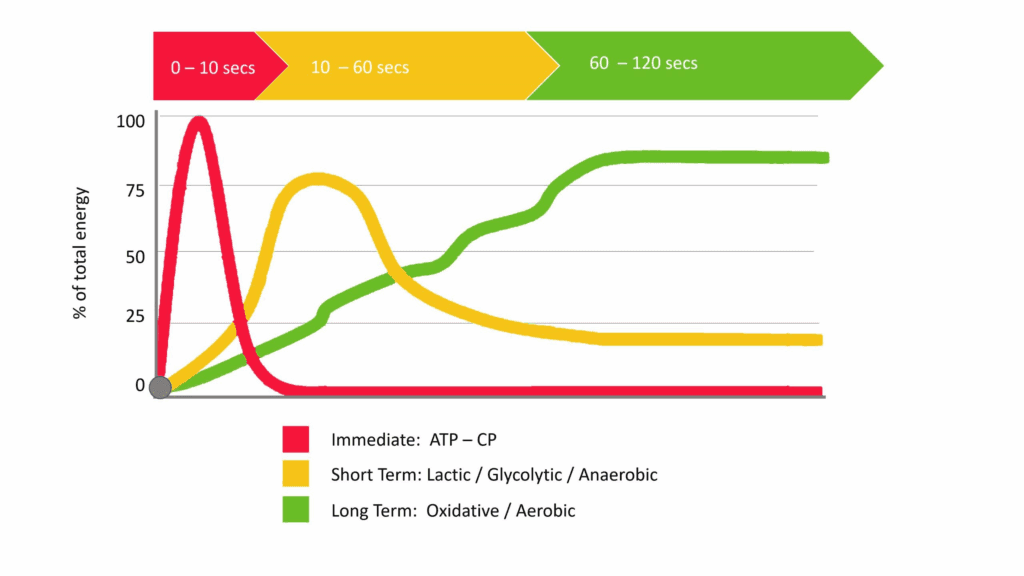
Anaerobic Alactic (a.k.a. explosive, powerful bursts)
- Max efforts lasting 0–12 seconds
- With 12–20 times as long rest: for example 5 seconds work = 60–120 seconds rest
- Think sprints and heavy lifts at 90-100% effort
- Uses stored ATP and creatine phosphate (hello creatine supplement!)
- No oxygen needed, no lactate produced
Anaerobic Lactic (a.k.a. spicy intervals)
- High-intensity efforts of 12–60 seconds
- With 3–5 times as long rest: for example 20 seconds work = 60–100 seconds rest
- Think 400m sprints, fast burpee sets at 80-100% effort
- Uses carbohydrates, no oxygen required; produces lactate. Lactate isn’t just a waste product – your body also reuses it as fuel once intensity drops!
Aerobic (a.k.a. endurance)
- Lower intensity, longer duration (60+ seconds to hours) with short or no rest
- Think steady running, cycling, hiking, or cleaning your house while dancing
- Fat oxidation is highest at lower intensities (60-70% heart rate, also known as zone 2). As you approach higher aerobic intensities (70–80% heart rate), the body increasingly relies on carbohydrates rather than fat
- Slower to activate, but built for endurance
Here’s the twist: all three systems are always working, but the intensity and duration of your activity determine which one dominates. For example, if you sprint all out, after about 12 seconds your intensity naturally drops. If you keep sprinting, around 30 seconds your speed starts to decline more, and after about 60 seconds, you’ll likely shift into a much slower tempo to finish that 5K run.
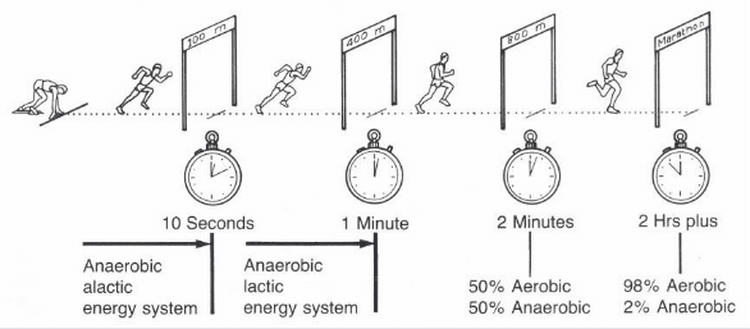
Now here’s another simplified example of how the energy systems relate to intensity and duration. Let’s say your friends unexpectedly come over to your house for a party. They haven’t brought any food or drinks. What do you do? At first, you serve them what you have in your fridge—quick and ready at hand, because it’s already present in your house. It runs out fast because your stock is limited. That’s your anaerobic alactic system, of which creatine is already present in your muscles to use right away and the performance is on high intensity and short. When your fridge is empty, the party is over. Or you have to go and get groceries…
Then there’s the anaerobic lactic system. You order fast delivery food—costs more money, comes quickly, but leaves more waste (hello lactate). Also the amount of food and drinks is limited. In the anaerobic system your body uses glucose to create only a little ATP, the energy is quickly available at high intensity (80-100%), but it takes a relatively long time to recover.
Finally, you decide to go grocery shopping—cheaper per meal, but takes way more time, but you get a lot of groceries. This is aerobic: it takes 1–2 minutes to get going but lasts for hours (if your mindset is strong enough to keep going as well), because in this system glucose and fatty acids create a lot of ATP.
How to Train Conditioning
Let’s say you want to get fitter. Great! But how often should you train your conditioning? For how long? And what if you already lift but want to run without losing your gains?
Before beginning any new conditioning program, especially high-intensity training, consult with your healthcare provider if you have underlying medical conditions or have been sedentary.
Let’s break it down into two categories: cardio-only and lifting-plus-cardio.
1. If You’re Only Doing Cardio
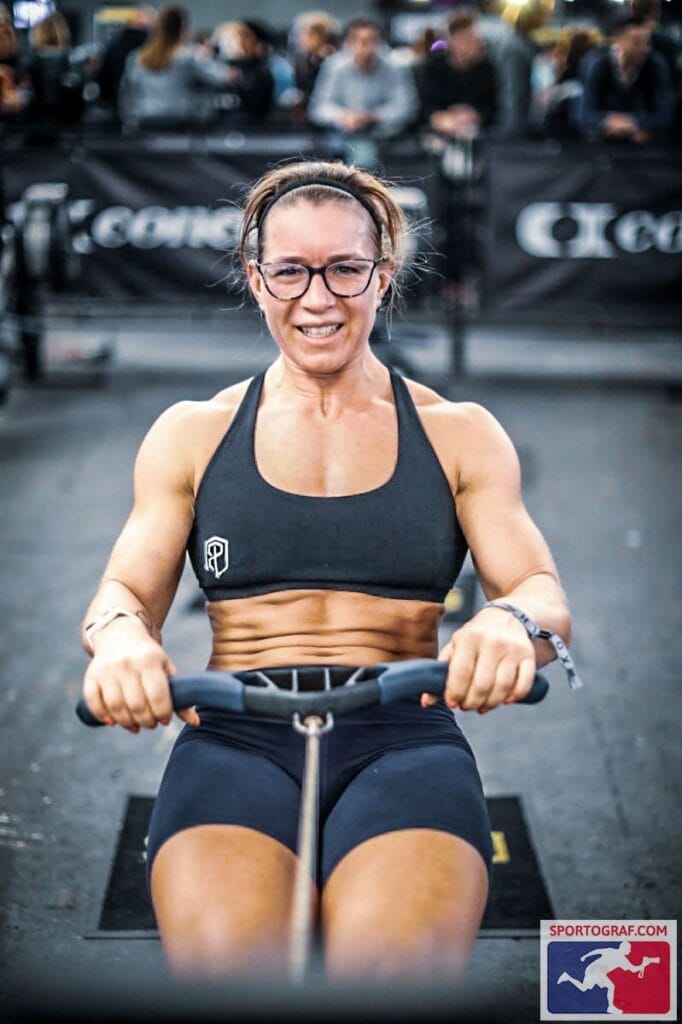
Cardio is fantastic for your heart, brain, and mood. But if your workouts only involve the elliptical while watching Netflix or long walks (with a heart rate under 60%), you’re missing out on the benefits of intervals, strength, and movement variety.
- Train 3–5x per week. Your heart and lungs need consistent stimulation to adapt.
- Vary your intensity: include both steady-state and interval training at a respective 80% to 20% ratio.
- Keep HIIT to 1–3x per week. More High Intensity Interval Training isn’t better. If you want more, choose lower intensity aerobic activities (60-80% heart rate) for a minimum of 20 minutes.
- Add strength training: It supports your endurance and keeps your muscles and joints strong. Try 1–2 lifting sessions weekly. Even bodyweight training counts if you’re just getting started. For example: do 4 strength exercises like push ups, deadlifts, rows and squats. Followed by a 20-30 minutes conditioning session.
If you’re intimidated by running or HIIT, start with something accessible: brisk walking, cycling, dancing in your living room with a guided YouTube video. All movement counts.
2. If You’re Only Lifting
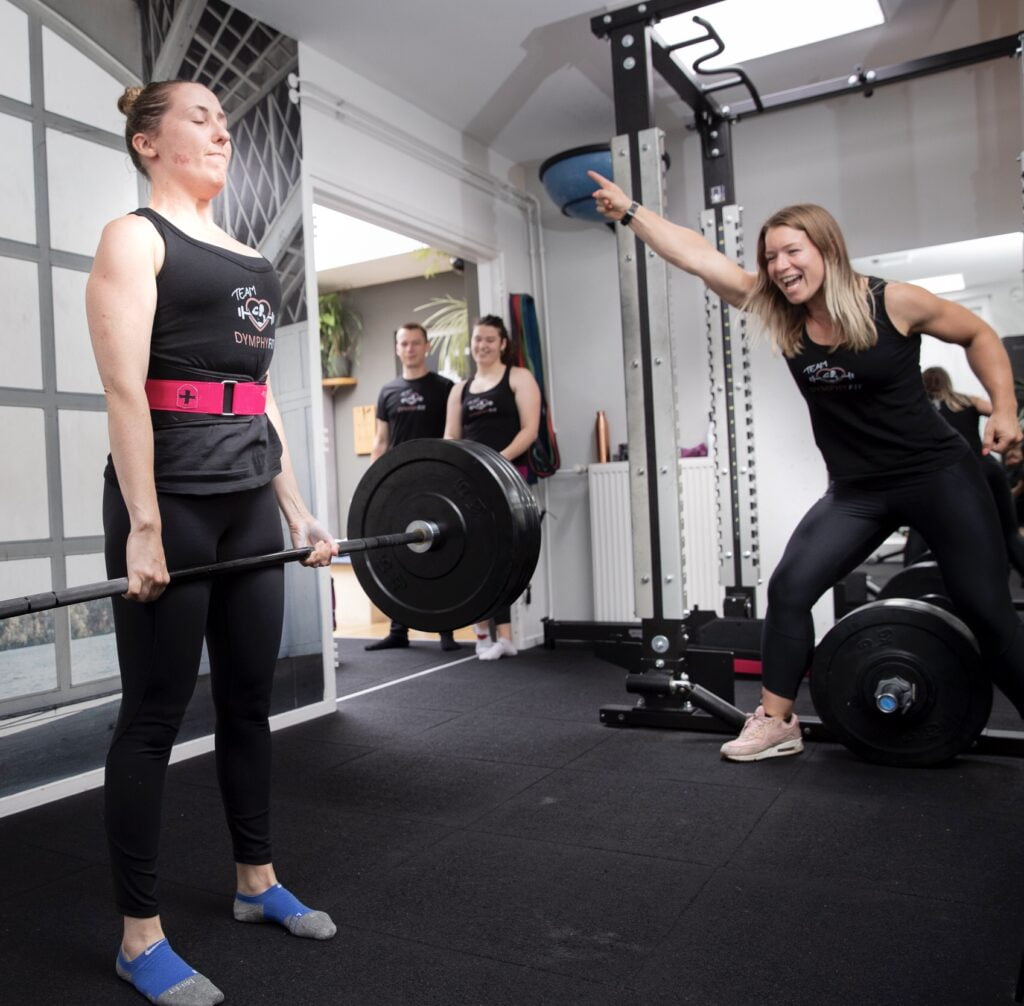
Lifting builds muscle, bone density, and the confidence to carry all your groceries in one trip. But if you skip cardio, your heart and lungs might underperform, especially when your rest periods shrink.
Why is conditioning beneficial for strength training? Conditioning improves your intra-session recovery, between-set energy, and long-term recovery by enhancing circulation and aerobic capacity.
- Add 2–3 conditioning sessions per week.
- Use low-impact options that don’t wreck recovery (e.g., incline walking, cycling, rowing).
- Start with short finishers after lifting (e.g., 10-20 min moderate effort), or train on separate days (e.g., 20-40 min low effort).
How to Combine Strength + Conditioning
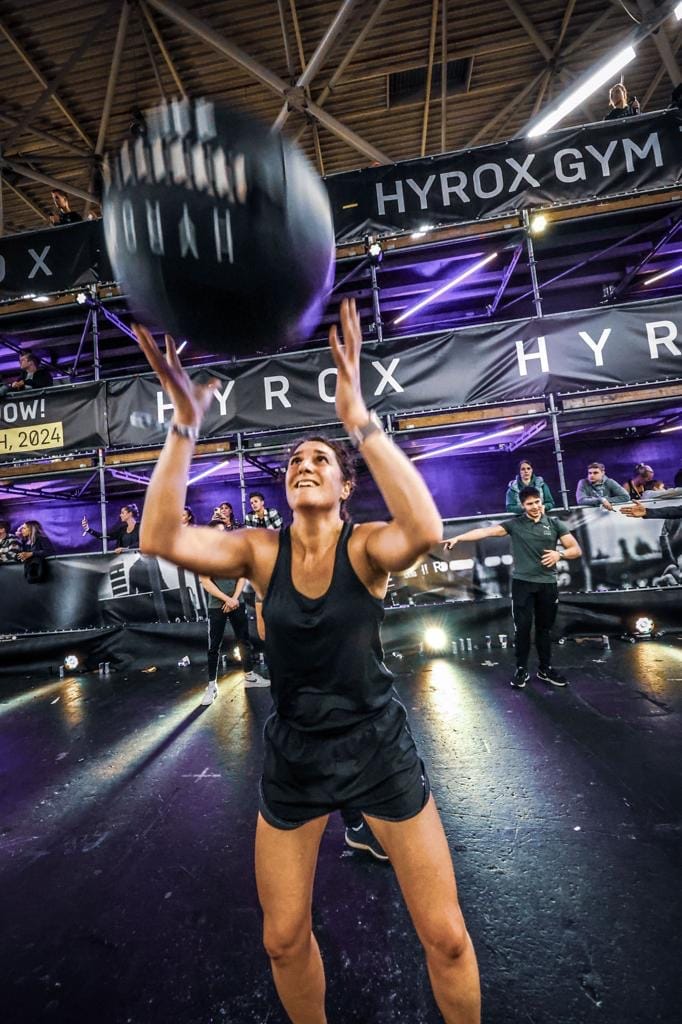
You don’t have to choose. These days, “hybrid training” is trending—hello HYROX and CrossFit! The real gains come from combining both smartly:
- Strength training builds the structure, resilience, and force production capacity.
- Zone 2 cardio (low intensity) builds your aerobic base. Train at 60–70% of max heart rate, where you can still hold a conversation. Example: 20–90 min bike ride or hike.
- High Intensity Interval Training (HIIT) develop speed, power, and lactate tolerance. Example: 6–10 x 30 sec sprints with 90 sec rest.
- High Intensity Training (HIT) blends strength and cardio. Example: AMRAP in 20 mins – 15 cal row, 12 box jumps, 10 pull-ups, 8 burpees.
Think of your body like a car (oversimplified, but helpful):
- Strength = engine power
- Conditioning = fuel efficiency
- Mobility & recovery = maintenance and repairs
Measuring Progress in Your Conditioning Training
Improving your conditioning isn’t just about working harder—it’s about working smarter with clear goals and measurable progress. Here’s how to track your conditioning improvements effectively over time.
Track Key Conditioning Metrics
Focus on measurable physiological improvements that indicate better conditioning:
- Resting Heart Rate: Should decrease as cardiovascular efficiency improves
- Heart Rate at Specific Power Outputs: Should decrease, showing improved efficiency
- Heart Rate Recovery Speed: Should increase, indicating better recovery capacity
- Average HRV (Heart Rate Variability): Should increase, showing better adaptation to training stress
- VO2 Max: Can typically increase by 2-4 points in a training block
- Power at Anaerobic Threshold (ANT): Should increase, showing ability to sustain higher intensities
Build Your Personal Testing System
At Dymphy Fit we create a standardized testing method that works for your lifestyle and goals. This isn’t a one-size fits all approach—it’s about developing consistent assessments that reveal your weaknesses and track your improvements over time.
Your testing will focus on movement quality over quantity. The question isn’t just “how many reps can you complete?” but “how many reps can you complete with excellent form?” We use video recording to review your performance objectively and provide feedback for future sessions.
Set Clear Block Goals (6-12 Week Training Blocks)
Your conditioning training should be organized into focused 6-12 week blocks, each with specific, measurable goals. Rather than training aimlessly, each block should target particular improvements based on your initial testing and assessment.
Your block goals should follow four key criteria: they must be important to your overall fitness, measurable with concrete numbers, specific to your current level, and achievable within the timeframe. Here are some specific examples:
- Increase HRV by 5 BPM
- Improve heart rate recovery by 10 BPM within 60 seconds
- Increase VO2 max by 2-4 points
- Decrease resting heart rate by 3-5 BPM
- Reduce heart rate at a given power output by 5-8 BPM
Remember, these numbers will vary significantly based on your starting fitness level, so work with realistic targets for your current abilities.
Progress Through Strategic Challenges
As your body adapts to training stress, you need to systematically increase the challenge to continue improving. This progression can happen through several methods:
- Volume Changes: Increase the number of reps, sets, or total training time
- Load Progression: Add weight or resistance to increase metabolic demand
- Heart Rate Zones: Train at higher heart rate zones as fitness improves
- Recovery Manipulation: Decrease rest intervals between exercises or sets
- Exercise Variation: Introduce new movement patterns to challenge your body differently or add more complexity
Remember that adequate rest between sessions is essential to prevent overtraining and allow your body to adapt. For more recovery strategies, see our blog “Recover Right: Why Recovery Matters More Than You Think.”

Set Realistic Expectations
Remember that specific improvement numbers vary dramatically based on your starting fitness level. A beginner might see rapid improvements in all metrics, while an advanced athlete might focus on smaller, more targeted gains. The key is setting achievable goals based on your current baseline testing rather than comparing yourself to others.
Understanding Your Genetic Blueprint
Genetic factors play a significant role in your conditioning potential, influencing your cardiovascular endurance capacity, recovery speed, and how quickly you adapt to training. Your genetics affect key performance markers like VO₂ max potential, muscle fiber composition, and your natural inclination toward endurance or power activities.
Think of the difference between a lean marathon runner and a muscular sprinter—their muscle fiber types (slow-twitch vs. fast-twitch) are naturally suited to different demands. However, this doesn’t limit what you should pursue. If you’re naturally built like a distance runner but love sprinting, go for it! When you commit to improving your performance through consistent training and lifestyle choices, you will see progress.
At your peak performance, you might find that some people outperform you in certain areas, while you excel in others. This is simply the reality of human variation. Focus on maximizing your own potential rather than comparing yourself to others’ genetic advantages.
By following this systematic approach to measuring and progressing your conditioning, you’ll see consistent improvements while avoiding the frustration of unfocused training. Each 6-12 week block builds upon the last, creating long-term conditioning gains that translate to better performance in all areas of your fitness.
Conclusion
Improving your conditioning doesn’t mean you have to run marathons (unless you’re in your thirties and you follow the latest trends). It means becoming more efficient, more energized, and more capable in whatever you love doing—lifting, dancing, chasing your kids, or climbing a mountain (you know who you are!).
Train smart, mix it up, and remember: the goal isn’t to suffer—it’s to get better.
In the end, conditioning is energy management. It’s about training your brain and body to handle the physical and mental demands of whatever challenge you face—whether that’s a competition, a hard workout, or just a long day on your feet.
Want to test your conditioning? Try 1 minute of max burpees or a 12-minute run. Log your total reps or distance, and measure your heart rate when you finish and the drop in the first minute. This shows how well you recover.
In personal training we guide our clients in their goal setting, whether it is conditioning, strength or a combination. As your coach, it’s my job not just to build your fitness—but to prepare you for real-world performance. Whether that means climbing mountains, smashing a CrossFit WOD, or simply feeling more energized in daily life, your program is tailored to meet your environment.
Do you want to get fitter? Ready to breathe easier in your next session? Let’s go!
Looking for a real deep dive into conditioning training? We recommend:
- Peter Attia’s podcast and YouTube channel
- Milo Education – Personal Trainer Course (online and in person course)
- Joel Jamieson – BioForce Conditioning Course (online course)
Dymphy has been a fitness enthousiast since 2008 and has been working as a personal trainer since 2013. She knows better than anyone the mental challenges of “the couch magnet” where you prefer to sit on the couch after a long day at work rather than train or thoughts such as
“I can also have a nice glass of wine tonight instead of training.”
She is fascinated by the psychological and physiological principles that underlie this. In a nutshell:
Motion leads to emotion. You produce happiness hormones dopamine and endorphins. Exercise instantly makes you feel better!
She works with different methods to get you moving. Interested? Book your free trial session now.
Our expertise
Personal training for high performers IN AMSTERDAM OUD-WEST

Strength

Slim

Mom (to be)

Fundamentals (beginners)
