
Everything About Fat Loss: Answering Your Burning Questions
Ever feel like fat loss is a mysterious process that your body performs behind closed doors? You’re not alone! When clients come to me, they often have the same puzzled expressions: “What exactly happens when I lose fat? Am I burning fat during my workout? Is the fat on my plate the same as the fat on my hips?”
If you’ve been wondering about these questions too, you’re in the right place. In this blog, I’m pulling back the curtain on the science of fat loss to finally make things click.
1. What Is Fat Loss, Really?
Fat loss is the process where your body breaks down stored fat and uses it as fuel. But here’s the critical part many people miss: net fat loss-a reduction in total body fat stores- only happens when you’re in a sustained energy deficit – meaning you consistently consume fewer calories than your body burns.
Your body’s daily energy expenditure comes from four sources:
- Basal Metabolic Rate (BMR): The energy your body needs just to exist – breathing, pumping blood, maintaining body temperature (60-75% of daily expenditure)
- NEAT (Non-Exercise Activity Thermogenesis): All your spontaneous movement – walking, fidgeting, cleaning, even tossing and turning in your sleep
- TEF (Thermic Effect of Food): The energy required to digest and process what you eat (around 10% of food calories)
- EAT (Exercise Activity Thermogenesis): The energy burned during planned workouts
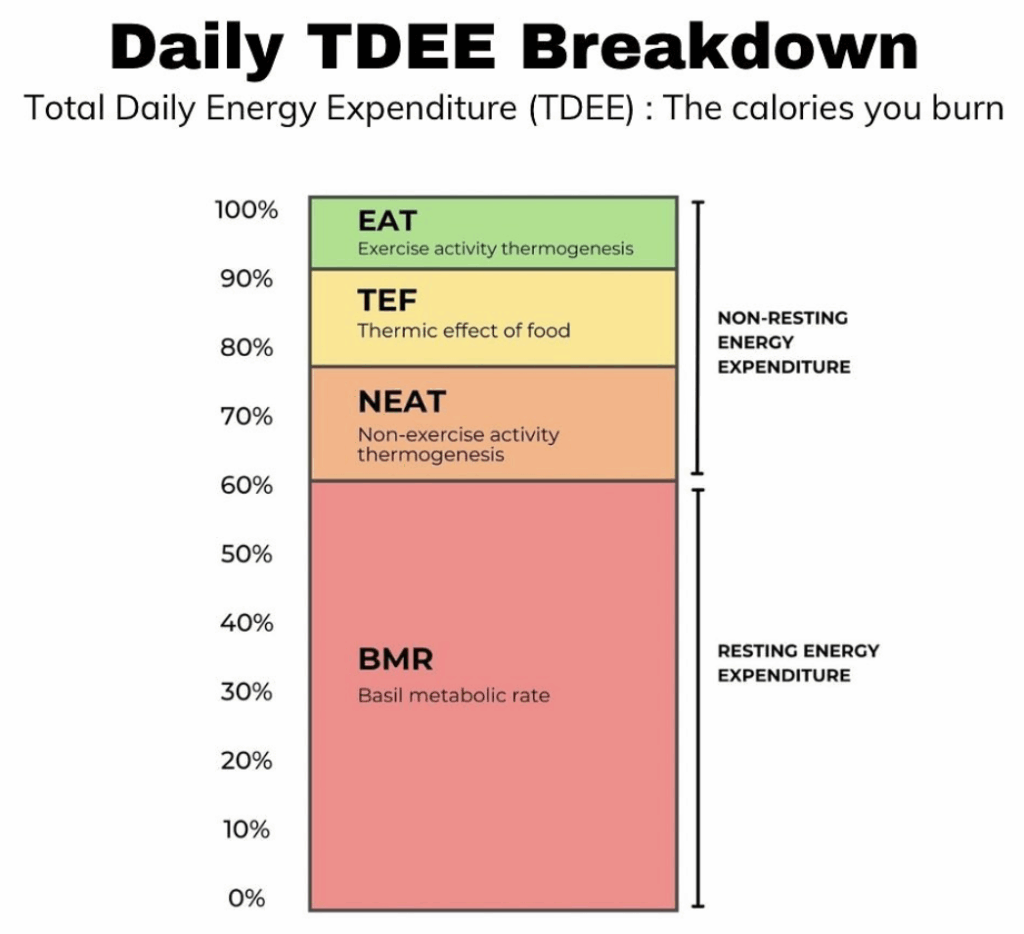
Fat loss occurs when: BMR + NEAT + TEF + EAT > Calories consumed
Think of your body like a bank account. Food is your income. Your movement, digestion, and cellular functions are your expenses. If you consistently spend more than you earn, you’ll need to dip into your savings account – that’s your fat stores. Keep this up, and your “fat savings” will gradually decrease.
2. What’s the Difference Between Fat Burning and Fat Loss?
Here’s where many people get confused – these terms sound similar but refer to different processes:
Fat burning is the moment-to-moment process of using fat as fuel. Your body does this all the time, even when you’re not trying to lose weight. During low-intensity activities like walking, cycling, jogging (called zone 2 training, which is up to 70% of your heart rate), your body preferentially uses fat as fuel because fat burns efficiently when oxygen is plentiful.
Fat loss is the cumulative result over time – the actual reduction in your body’s fat stores that happens only when you maintain a calorie deficit.
Think of it this way: Fat burning is what your car does with gasoline during a drive. Fat loss is what happens to your gas tank after many drives without refilling. You can be “burning fat” during your workout but still not losing fat overall if you eat more calories than you burn throughout the day. (Bummer, I know!)

3. Is the Fat I Eat the Same as the Fat I Lose?
Not exactly, though they’re chemically similar (both are triglycerides).
Dietary fat (from foods like nuts, avocados, oils, and fatty fish) can be:
- Used immediately for energy
- Used to build hormones and cell membranes
- Stored as body fat if you consume excess calories
Body fat is your stored energy reserve, which gets broken down when you need more energy than you’re taking in.
Here’s an important point many people miss: when you consume more calories than you burn, those excess calories get stored as body fat – but they can come from any macronutrient, not just dietary fat. Carbohydrates, proteins, and fats can all be converted to body fat when consumed in excess.
However, there’s a significant caveat: highly processed foods tend to be associated with weight gain and increased fat storage, though not necessarily due to insulin spikes. The primary issues with processed foods are:
- Palatability: They’re designed to be extremely tasty, making it easier to overeat
- Energy density: They typically pack more calories into smaller volumes
- Poor appetite regulation: They often fail to trigger normal satiety signals, leading to higher overall consumption
- Fast consumption: We tend to eat them quickly, not giving our bodies time to register fullness
These factors combined lead to increased total calorie intake (3), which is the true driver of fat storage—not something inherently unique about how processed foods are metabolized.
It’s like comparing new inventory coming into a warehouse (dietary fat) versus inventory that’s been sitting on the shelves for months (body fat). They might be similar products, but they play different roles in your business operations. And while all products can be stored in the warehouse when there’s excess, some items (processed foods) seem to get priority shelf space in your fat storage department.
4. When Does Your Body Burn Fat?
Your body is constantly switching between burning fat and carbohydrates depending on:
- Your activity level
- Your hormone levels
- When and what you last ate
The key hormone that regulates this is insulin. After a meal – especially one high in carbs – insulin rises to help shuttle glucose (blood sugar) into your cells. While insulin is elevated, your body prioritizes burning glucose and puts fat burning on the back burner.
Different carbohydrates affect your insulin response differently. Simple sugars and refined carbohydrates (like white bread, candy, and soda) cause rapid spikes in blood glucose, triggering a strong insulin response. Complex carbohydrates (like whole grains, legumes, and vegetables) lead to a more gradual rise in blood sugar and a more moderate insulin response.
This matters because the higher your insulin levels and the longer they stay elevated, the longer your body remains in “sugar-burning mode” rather than “fat-burning mode.” Foods that cause dramatic blood sugar spikes can keep insulin elevated for hours, effectively blocking fat metabolism during that time. For a deeper dive into how sugar affects your health and strategies to reduce your consumption, check out my previous blog “Breaking Free from Sugar: Steps to a Healthier You.”
Once insulin drops – usually 2-3 hours after eating, during overnight fasting, or between meals – your body can more easily access fat stores for energy. Imagine insulin as a traffic controller. After eating, it directs traffic toward the sugar-burning highway and puts up a “Road Closed” sign on the fat-burning path. Once insulin levels drop, the fat-burning road opens back up for business.
5. How Does Fat Burning Work on a Biological Level?
Let’s peek under the hood at the fascinating process of fat metabolism:
- Lipolysis: Stored triglycerides in your fat cells get broken down into free fatty acids and glycerol
- These components are released into your bloodstream
- Muscles and organs take up these fatty acids
- Inside cell mitochondria (your cellular power plants), fatty acids undergo beta-oxidation, converting to acetyl-CoA
- Acetyl-CoA enters the Krebs cycle, producing energy (ATP) plus carbon dioxide and water as byproducts
And here’s the mind-blowing part – you literally exhale your fat! The carbon from fat leaves your body primarily as carbon dioxide when you breathe out, while the water component leaves through urine, sweat, and breath vapor.
Next time someone asks where your lost weight went, you can confidently say, “I breathed it out!” (And yes, that’s scientifically accurate!)
6. When During the Day Am I Burning the Most Fat?
Your body’s fat-burning potential varies throughout the day:
- During sleep: This is prime fat-burning time. With low insulin and several hours without food, your body relies heavily on fat for fuel.
- 2-3 hours after meals: Once insulin levels drop, fat burning increases. If you space meals 3-5 hours apart, you give your body windows of lower insulin where fat burning is enhanced.
- During low to moderate-intensity exercise: Activities like walking, jogging and cycling primarily use fat for fuel. Check out our blog about Zone 2 training.
- After intense exercise: While there is a modest “afterburn effect” (EPOC – Excess Post-exercise Oxygen Consumption) that can slightly increase metabolism, its impact on fat oxidation is relatively small compared to your overall calorie balance.
It’s important to understand that while your body may be “burning fat” during these times, this doesn’t automatically translate to fat loss. The total calorie balance throughout the day is still the primary determinant of whether you’ll lose fat over time. These periods simply represent when your body preferentially uses fat as its fuel source.
7. Does Fasted Training Boost Fat Loss?
Fasted cardio (exercise on an empty stomach, typically in the morning) does increase fat oxidation during the workout. Your insulin is low, so your body can more easily access fat stores. However – and this is important – studies show this doesn’t necessarily translate to greater overall fat loss. Research comparing fasted versus fed exercise found similar fat loss results when calorie intake was the same (4, 6).
For women especially, the picture gets more complicated. According to female physiology expert Dr. Stacy Sims (7), fasted training can potentially:
- Raise cortisol (stress hormone) levels
- Increase belly fat storage
- Impair muscle recovery
- Disrupt hormones, especially during the luteal phase (second half) of your menstrual cycle
Some research has found that protein intake prior to exercise causes greater increases in post-exercise energy expenditure compared to carbohydrate (5, 8). Many of my female clients find they perform better and feel more energized with a small pre-workout snack, such as a banana and a protein shake. This helps maintain stable blood sugar and protects lean muscle without significantly impacting fat utilization.
8. How Can I Optimize Fat Loss Based on All This Science?
Now that you understand the mechanics of fat loss, here are actionable strategies:
- Create a sustainable calorie deficit (typically 20% or 300-500 calories below maintenance)
- Space your meals 3-5 hours apart to allow insulin to decrease between feedings
- Prioritize protein (aim for 1.6-2.2g per kg of body weight daily, spread across meals)
- Strength train regularly to preserve muscle mass while in a deficit
- Increase your NEAT (take the stairs, park farther away, clean vigorously – it all adds up!)
- Get 7-9 hours of quality sleep to optimize hormones that influence fat metabolism
- Manage stress levels as chronic stress promotes fat storage, especially around the abdomen
- Stay hydrated – water is essential for all metabolic processes, including fat metabolism
Remember that fat loss isn’t just about looking good on the beach – it’s about creating sustainable habits that support your overall health, energy, and confidence.

The Bottom Line
Fat loss might seem complex (and biologically speaking, it is!), but the principles for achieving it are straightforward: maintain a moderate calorie deficit, move regularly, prioritize protein and whole foods, and give your body the rest it needs.
Understanding how your body loses fat can help you make smarter choices and have more realistic expectations about your progress. And remember – despite what many fitness influencers might claim, there are no magical fat-burning zones, supplements, or workout techniques that override these fundamental principles.
The truth is, doing the basic, “easy” work consistently is what’s actually hard. It requires discipline and perseverance to show up day after day, making small choices that align with your goals when no one is watching. This steady approach rarely makes for exciting social media content, but it’s what genuinely delivers lasting results. The path to sustainable fat loss isn’t about finding shortcuts or hacks—it’s about embracing the power of consistent habits applied over time.
The path to sustainable fat loss isn’t about breathing harder to exhale more fat (though now you know that’s technically what happens!). It’s about creating an environment where your body can safely access stored energy while preserving muscle and keeping hormones happy.
If you’re ready to put this knowledge into action with a personalized approach, I’d love to help you create a plan that works with your body’s natural processes, not against them. Because when it comes to fat loss, working smarter beats working harder every time!
Ready to breathe out some fat? (See what I did there?) Reach out today to schedule your intake!
References
- Aragon, A. A. (2022). Flexible dieting: A science-based, reality-tested method for achieving and maintaining your optimal physique, performance & health. Victory Belt Publishing.
- Carpenter, B. (2023). Everything fat loss: The definitive no bullsht guide*. BDCC Fitness.
- Guyenet, S. J. (2017). The hungry brain: Outsmarting the instincts that make us overeat. Vermilion.
- Hackett, D., & Hagstrom, A. (2017). Effect of overnight fasted exercise on weight loss and body composition: A systematic review and meta-analysis. Journal of Functional Morphology and Kinesiology, 2(4), 43. https://doi.org/10.3390/jfmk2040043
- Hackney, K. J., Bruenger, A. J., & Lemmer, J. T. (2010). Timing protein intake increases energy expenditure 24 hours after resistance training. Medicine & Science in Sports & Exercise, 42(5), 998–1003. https://doi.org/10.1249/MSS.0b013e3181c1297
- Schoenfeld, B. J., Aragon, A. A., Wilborn, C. D., Krieger, J. W., & Sonmez, G. T. (2014). Body composition changes associated with fasted versus non-fasted aerobic exercise. Journal of the International Society of Sports Nutrition, 11(1), 54. https://doi.org/10.1186/s12970-014-0054-7
- Sims, S. T., & Yeager, S. (2016). Roar: How to match your food and fitness to your unique female physiology for optimum performance, great health, and a strong, lean body for life. Rodale Books.
- Wingfield, H. L., Smith-Ryan, A. E., Melvin, M. N., Trexler, E. T., Roelofs, E. J., & Hirsch, K. R. (2015). The acute effect of exercise modality and nutrition manipulations on post-exercise resting energy expenditure and respiratory exchange ratio in women: A randomized trial. Sports Medicine – Open, 1(1), Article 11. https://doi.org/10.1186/s40798-015-0010-3

Dymphy has been a fitness enthousiast since 2008 and has been working as a personal trainer since 2013. She knows better than anyone the mental challenges of “the couch magnet” where you prefer to sit on the couch after a long day at work rather than train or thoughts such as
“I can also have a nice glass of wine tonight instead of training.”
She is fascinated by the psychological and physiological principles that underlie this. In a nutshell:
Motion leads to emotion. You produce happiness hormones dopamine and endorphins. Exercise instantly makes you feel better!
She works with different methods to get you moving. Interested? Book your free trial session now.
Our expertise
Personal training for high performers IN AMSTERDAM OUD-WEST

Strength

Slim

Mom (to be)

Fundamentals (beginners)
